
Hawaii — The Odyssey (Part 2)
Disclaimer: This post contains minor spoilers already available online through interviews and reviews.
During our stay in Hawaii, we went to see The Odyssey. 오디세이 (o-di-se-i) in Korean.
Our show started at 10 p.m. Armed with a box of popcorn, I braced myself for a nearly three-hour marathon after a full day of swimming in the ocean. I found myself munching on the popcorn, not to stay awake, but to stop myself from biting my fingernails as Odysseus fought his way home, or tried to.
As the ending credits started rolling, James Blake’s haunting yet beautiful voice filled the still dark theater.
Outside, while waiting for a taxi, we talked about Christopher Nolan’s dedication to filmmaking. Real locations, practical effects and real ships on real seas. Old-school movie magic. The actors were out there, working with the water and weather. Even the dolphins were real. (Not a spoiler, if you’re wondering.) Our taxi arrived.
It was, appropriately, another Odyssey. The Honda kind.
And there was Ludwig Göransson’s score. We kept replaying it over the next few days. The rising music, the pounding drums, the sounds carrying one scene crashing into the next.
Göransson researched instruments associated with the ancient Greek world, including the lyre and the aulos, a double-pipe reed instrument. He described it as “the most popular rock star instrument for a thousand years.” The score also used bronze gongs alongside modern sounds. To our non-expert ears, the music felt both ancient and otherworldly—probably exactly what Christopher Nolan intended.
For the next few days, we couldn’t stop reading and watching stories about the movie. The film had ended, but it had left us talking and wandering down one rabbit hole after another.
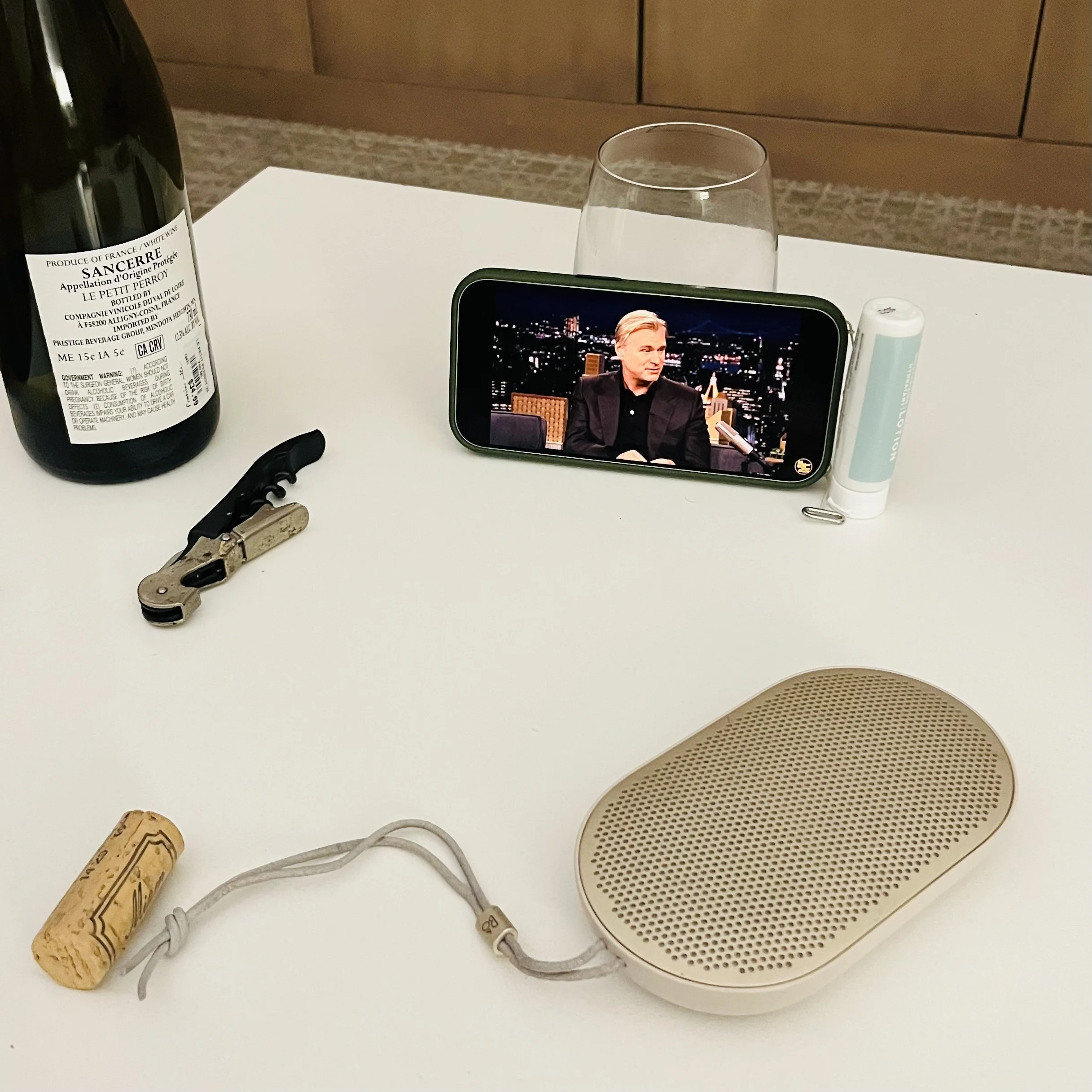
Back at the hotel after the movie, watching Christopher Nolan’s interview with Jimmy Fallon.
Online, one argument was gathering steam: How could a movie pay so much attention to ancient instruments while using ships and armor that weren’t period-accurate?
A few days after the film opened, Elon Musk joined the debate. He announced that Grok Imagine would make a full-length version of The Odyssey before the end of the year. One that would be, in his words, “historically accurate and true to the art of Homer.”
But “historically accurate” is a complicated promise for a story filled with gods, monsters and magic. Especially since The Odyssey is not a historical record.
Accuracy was not what had us so immersed anyway.
What stayed with us was the feeling of realness. The light on the water. The weight of the ships. The actors crowded into physical spaces. The sound of bronze, reeds, and drums building around them.
There’s another interesting layer to the word odyssey. Today, it can mean any long, wandering and eventful journey. In Homer’s poem, Odysseus’s grandfather Autolycus gives him his name, connecting it with anger and grievance. Appropriate for a man who both suffers and causes suffering.
At its heart, the story is about Odysseus’s journey home. But it’s everything along the way that makes it an odyssey.
That’s what I want from a movie. Not necessarily the most accurate version. I want to feel the wind and the water. I want to be immersed, overwhelmed, carried somewhere else.
I’m in it for the ride.
(On a completely different note, I wrote much of this while waiting in line at Stüssy Hawaii, hoping to get the elusive Honolulu edition. But that’s another odyssey, and another post entirely.)
